In this guide
Almost everything written about self-hypnosis falls into one of two camps. The first treats it as something close to magic, with language about the subconscious doing work no one can describe. The second dismisses it as suggestion and placebo, which is closer to the truth but stops exactly where the interesting part begins.
What follows is the middle: what the state actually is, what is known about why it helps, and how to use it — with the limits stated plainly rather than buried.
The state itself
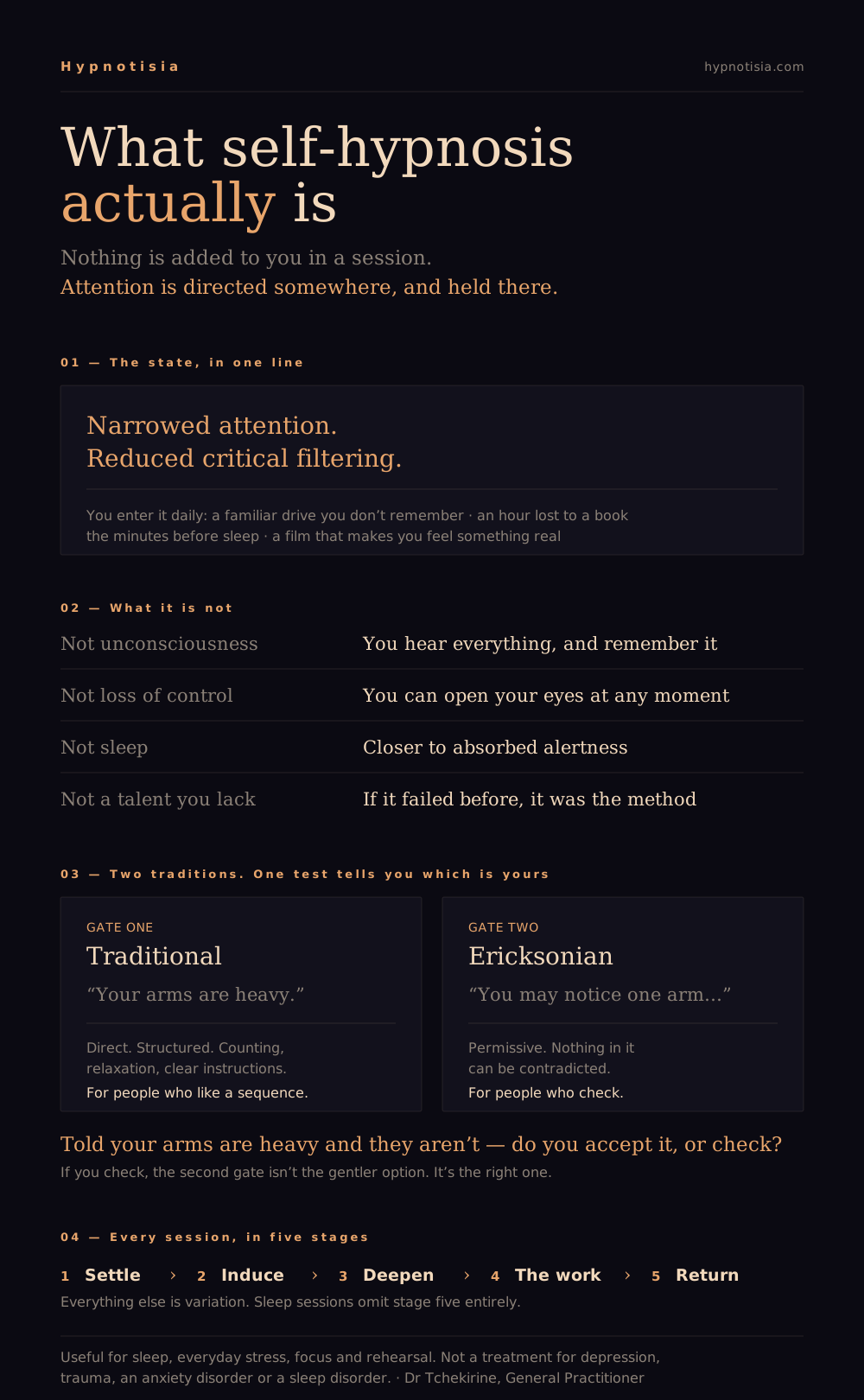
Hypnosis, stripped of the theatre, is a state of narrowed attention with reduced critical filtering. That is the whole definition. Attention becomes concentrated on a small field, and the part of the mind that ordinarily challenges every statement becomes less active.
You have been in it many times today already.
Driving a familiar route and arriving with no memory of the journey. Losing an hour to a book and looking up surprised at the time. The few minutes before sleep when thoughts stop being sentences and start being images. Watching a film and feeling something real about people who do not exist.
None of those required a practitioner, a pendulum, or a belief. They happened because attention narrowed and stayed narrow. Self-hypnosis is the deliberate version: you produce the state on purpose, and you point it at something.
Nothing is added to you in a session. Attention is directed somewhere, and held there.
What it is not
It is not unconsciousness. You hear everything. You remember the session afterwards. People routinely finish a first session convinced nothing happened, precisely because they expected to be absent and instead were entirely present.
It is not loss of control. You can open your eyes and stand up at any moment, and nothing keeps you in the state. Stage hypnosis creates the opposite impression by selecting volunteers who are comfortable performing in front of an audience — that is showmanship, not the technique.
It is not sleep. The word comes from the Greek for sleep, which has caused a century of confusion. The state is closer to absorbed alertness. Physiologically, someone in a session and someone asleep look nothing alike.
And it is not something you either can or cannot do. Suggestibility varies between people, and a small proportion respond unusually strongly or unusually weakly. But the useful part — settling the body, occupying attention, rehearsing a response — works across that range. If it has failed for you before, the likely reason is the method rather than the capacity.
Why it works
Three mechanisms, and none of them require anything unusual to be true.
Arousal comes down, physically. A slow breath with a long exhale, a body released muscle by muscle, several minutes without movement — these lower physiological arousal reliably and measurably. This is not belief. It is the same effect you can feel within two minutes of your first attempt, whether or not you expect it.
Attention gets a job. A mind with nothing to hold generates its own material, which at midnight means the conversation from four years ago. Counting down, following warmth through the hands, tracking the weight of your legs — deliberately dull objects that occupy the stage the worry wants. "Clear your mind" fails because it offers an empty stage; this works because it offers a boring one.
Suggestions meet less resistance. In a settled, absorbed state, phrases like heavier, slower, further away tend to be taken at face value rather than argued with. Not because your judgement is suspended, but because the part of you that objects to everything has quietened along with the rest. That is also why rehearsing a difficult conversation in this state feels more like having done it than like having thought about it.
Two traditions
Nearly everything written on the subject belongs to one of two schools, and most sources teach only one without mentioning that the other exists. Knowing which one suits you is the single most useful thing on this page.
Traditional
Direct and structured. Your arms are heavy. Your breathing is slowing. Progressive relaxation, fixed inductions, counting down, clear present-tense suggestions. Efficient, and it suits people who like a sequence they can follow exactly.
Ericksonian
Indirect and permissive. You may notice one arm feels heavier than the other, and you don't have to decide which. Metaphor, open language, and the use of whatever is already happening — including your distraction — as the way in.
The hybrid session
Most useful sessions borrow from both: the structure of the first to get you down, the flexibility of the second to keep you there. Everything on this site is built that way.
Here is the practical test. When someone tells you your arms are heavy and they aren't, what happens? Some people simply accept it and find the arms grow heavy. Others immediately check, find the claim false, and conclude the technique has failed.
If you are the second kind, direct suggestion will always feel like being told a comfortable lie — and the permissive version is not a softer alternative, it is the correct one for you. Nothing in it can be contradicted by your experience, so there is nothing to check, and the checking is what was keeping you alert.
The anatomy of a session
Almost every effective session, in any tradition, moves through the same five stages.
- Settling. Two or three minutes of nothing demanding — the weight of the body, the breath finding a longer exit than entry. This is where arousal comes down. Skipping it is the most common reason sessions fail.
- Induction. Attention narrows to one thing: a point, a count, a sensation, a phrase. The narrowing is the induction; the specific object barely matters.
- Deepening. A slow descent — counting backwards, an image of going down, or simply more of the same for longer. It gives attention a direction and a rhythm.
- The work. Whatever the session is for: a suggestion, a rehearsal of something difficult, a metaphor, or nothing at all if the goal is rest.
- Return. A deliberate reorientation — count up, notice the room, open the eyes. With one exception: a session meant to end in sleep should have no alerting ending at all.
That is the entire architecture. Everything else is variation.
Your first session, tonight
You do not need a script, a recording, or a quiet hour. Five minutes and a chair.
Sit comfortably and close your eyes. Breathe in for four, out for six. Ten rounds. Small breaths rather than deep ones — the ratio matters, the volume doesn't.
Let go of three places. Jaw: let the teeth come apart. Shoulders: let them fall further than you think there is room for. Hands: let the fingers open. One out-breath each.
Count down from ten to one, one number per exhale, each one a little heavier than the last.
Then stop directing. Sit still for a minute with nothing to do. This is the part that feels like nothing is happening, and it is the part that works.
Come back by counting up from one to three, noticing the room, and opening your eyes.
What you should expect: slower breathing, warmer hands, heavier limbs — usually within two or three minutes of a first attempt. What you should not expect is drama. If you were waiting to feel hypnotised, you will decide it failed. It probably didn't; the state simply feels far more ordinary than the word suggests.
If your mind wanders
It will, repeatedly, and this is not failure. Notice it, and return to the count. Coming back is the practice — not the interruption of it. People abandon this method in week one because they measured themselves against an unbroken concentration nobody has.
What it cannot do
Self-hypnosis is genuinely useful for a specific and unglamorous list: falling asleep, everyday stress, focus, rehearsing something difficult before you do it, and small behavioural changes you already want to make. Within that list it works well, costs nothing, and improves with practice.
Outside it, the honest answer is that it is the wrong tool.
It is not a treatment for depression, an anxiety disorder, post-traumatic stress, psychosis, or a diagnosed sleep disorder. It does not recover reliable memories — attempting that risks producing confident false ones instead. It is not a substitute for assessment of pain that has never been examined. And for people with a trauma history, turning attention inward can surface more than expected; if that happens, the right response is to stop and work with a professional rather than push through alone.
A technique used to keep tolerating something that needs treating is the one way this material can do harm. Everything else on this site is written on that assumption.
Keep reading in this guide
Nine myths about hypnosis — mind control, getting stuck, recovering memories, "it's just placebo". Each one examined, including the two that are partly true.
The traditional method, step by step — how inductions work, four to use tonight, and the four rules that decide whether a suggestion holds.
The Ericksonian method — the permissive tradition: indirect suggestion, utilisation, metaphor, and the phrasings that make a session impossible to fail.
Where to go next
Self-hypnosis for sleep — the largest guide on this site: the mechanism, the four parts of a sleep session, and when sleeplessness needs a doctor instead.
Self-hypnosis for stress — why "just relax" backfires, and how to build a calm you can reach with your eyes open.
Common questions
Can everyone be hypnotised?
Suggestibility varies, and a minority respond unusually strongly or unusually weakly. But the useful components — lowering arousal, occupying attention, rehearsing a response — work across the whole range. A first attempt that felt like nothing usually points to the wrong method rather than an inability.
Is self-hypnosis the same as meditation?
They overlap in the calm they produce and differ in direction. Meditation generally cultivates open awareness without a goal. Self-hypnosis narrows attention deliberately and aims it at one outcome — sleep, focus, or rehearsal. Many people practise both.
Can I get stuck in it?
No. There is nothing holding you in the state; if a recording stopped mid-session you would simply drift or open your eyes. The worst realistic outcome of an unfinished session is falling asleep, which for most of these sessions is the intended result anyway.
How long before it works?
The physical part is immediate — most people feel it in the first two or three minutes. The rest is a skill: expect one to two weeks of near-daily practice before a session starts pulling you under on its own. Practising for a week and concluding it doesn't work is how people abandon something that would have worked in the third week.
Do I need a recording?
No, though it helps at first because it removes the effort of remembering the sequence when you are tired. Once the structure is familiar most people run it silently, which has the advantage of working in the middle of the night without reaching for a device.